South Korea Moves to Label AI Character Chats Harmful to Minors
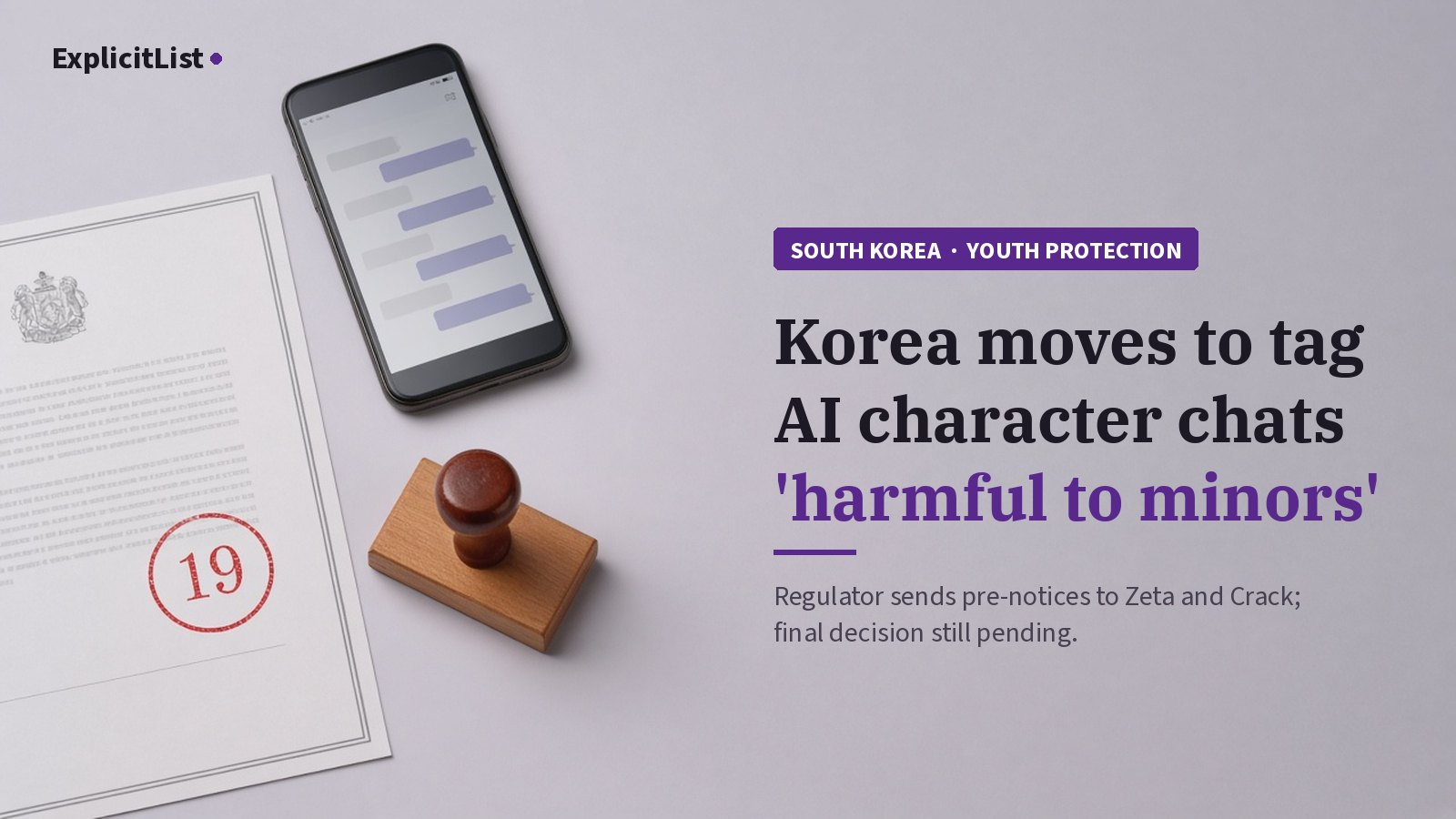
South Korea’s content regulator has started the formal process that could classify AI character chat services as media harmful to minors, a label that would force operators to add harmful-content marks and real age checks. The Broadcasting, Media and Communications Standards Commission (known in Korea as 방미심위) has sent advance notices to several AI chat operators, including Scatter Lab, which runs Zeta, and Wrtn Technologies, which runs Crack, according to ZDNet Korea on November 17.
No service has been designated yet. A commission official told ZDNet Korea that the regulator is collecting operators’ opinions and will then put the cases to a single review session. Digital Daily reported that the comment window ran until November 18 and that no date for a final decision has been set.
What a designation would mean
According to Digital Daily, the notices cite Article 7 of the Youth Protection Act, which lets the regulator decide that a medium is harmful to young people. The criteria in Article 9 include content that sexually stimulates minors. A designated service has to label the content as harmful, verify users’ ages and stop providing it to minors; violations can lead to corrective orders or criminal penalties, the paper said.
There is a precedent. In 2020 the government used the same law against “random chat” apps that lacked identity checks and reporting tools. A 2021 follow-up cited by Digital Daily found that 154 of 408 such apps had shut down or stopped selling.
How it got here
The commission met 15 AI chat operators on October 21 and said its monitoring had found character images with sexualised body exposure, profiles and tags suggesting sexual acts, and bots that produced sexual dialogue when users pushed them, according to its press release and Yonhap. It asked operators to separate adult and general content, use phone-based identity verification instead of a typed-in age, and filter both prompts and replies. A week earlier, the Ministry of Gender Equality and Family said its own test of chatbots usable without adult verification had turned up sexual, violent and self-harm responses.
Operators are already changing course
Scatter Lab said on November 17 that it had set up a trust and safety team reporting to its CEO and moved half of its main AI developers to moderation models, ZDNet Korea reported. Before the end of the year it plans a three-step content review, a three-hour daily limit for teen users and a default monthly spending cap of 100,000 won. Separately, new downloads of Zeta on Apple’s App Store have been unavailable since November 7; the company says Apple has not told it why.
Wrtn plans to raise Crack’s iOS age rating from 15+ to 18+, responding to Apple’s new 18+ rule for AI companion apps, which took effect on November 16.
Why it matters
Korean apps are now sizeable players in AI character chat: Scatter Lab booked 70.9 billion won in revenue in the first half of 2026, and Zeta’s sales have been growing fast in Japan and the US, according to Digital Daily. If the commission goes ahead, adult roleplay in Korea would sit behind identity-based age verification rather than a checkbox. That is the same direction as Apple’s rating change and the App Store removals of companion apps we reported last week. More coverage of the sector is on our AI roleplay page.

